
First, check what you are being asked to do
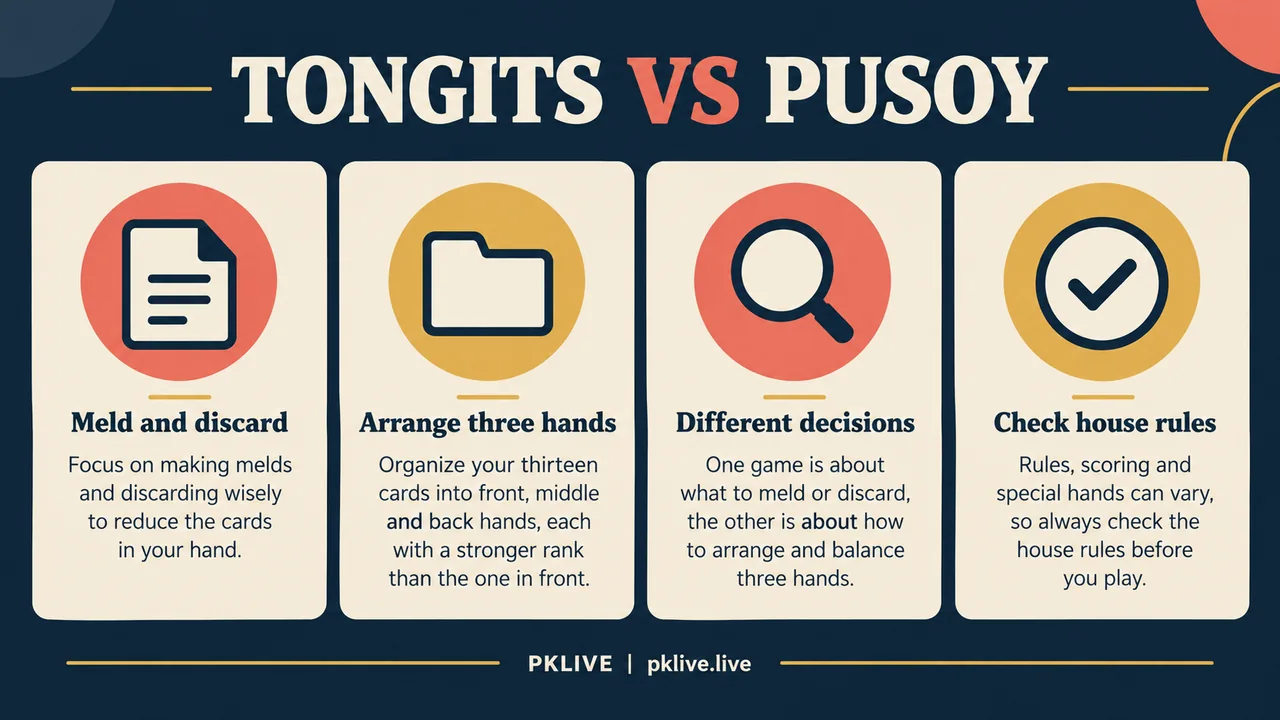
Someone invites you to play Pusoy, but you are expecting to draw a card and discard one. That mismatch matters more than recognizing the card suits. Traditional Tongits is a draw-and-discard game; the Pusoy discussed here asks you to arrange a dealt hand for comparison.
This guide compares traditional Tongits with arranged-hand Pusoy, also called Chinese Poker. Pusoy Dos is a different game. Online titles need their own rule check: a familiar name does not make every app use these rules. If the scoring or charge for a round is unclear, stop before agreeing to a stake.
By PKLIVE. Publication date: 2026-11-06. Sources checked October 17, 2026. For adults legally eligible to participate; this article does not establish account or regional eligibility.
The difference you can spot before the first turn
Pagat’s specialist rule descriptions provide the traditional baseline below. Use the table to recognize the activity at the table, rather than as permission to assume every local or online version works identically.
| What to notice | Traditional Tongits | Arranged-hand Pusoy |
|---|---|---|
| Players and deal | Three players; dealer gets 13 cards, others 12 | Four players; 13 cards each |
| Main action | Draw, form melds, optionally lay off, then discard | Divide cards into front, middle and back hands |
| What is compared | Unmatched points can decide a finished round | Corresponding hands are compared |
| What to check locally | Draw challenges and settlement | Special hands, ties and sweep payments |
A three-card run does not mean the same thing
In Tongits, sets and suited runs are useful combinations. A run needs at least three consecutive cards of one suit; a set uses matching ranks. Aces are low. The aim includes reducing unmatched points, not building a single poker hand.
Consider 4♥, 5♥ and 6♥. In a Tongits explanation, you would ask whether they form a meld and how the remaining cards fit. Now put those same cards in Pusoy’s three-card front hand. Under Pagat’s ordinary rules, that front hand gets no straight or flush value. It is evaluated as high card.
This is a useful paper exercise when learning with friends: write the game name above the cards before naming the combination. If you cannot explain why the label changes, return to the rules before trying to compare scores.
Pusoy makes you account for all thirteen cards
The ordinary arrangement has three cards in front and five each in the middle and back. The back must outrank the middle, and the middle must outrank the front. Pagat describes ordinary poker rankings for the five-card hands.
Here is an invented arrangement for reading practice, not a suggested winning hand. Front: 2♣, 2♦, 7♥. Middle: 8♣, 8♦, J♠, 9♥, 4♣. Back: Q♣, Q♦, Q♥, 6♠, 3♦. All thirteen cards are different. The pair of eights outranks the pair of twos, and the three queens outrank the middle pair.
After checking that arrangement, ask a separate question: what does each opponent have in the corresponding position? Nothing in our example answers that. A neat arrangement establishes neither a win nor the amount a player will receive.
What actually ends the comparison?
Tongits can end when someone uses up their cards, the stock runs out, or a permitted Draw challenge is resolved. Calling Draw has conditions; it is not simply announcing that your hand looks good.
Pusoy settlement needs its own agreement. Pagat documents different payment systems, so a household rule cannot establish an online product’s charges. These are the questions worth asking before the cards are dealt.
| Question | Why ask it? | Evidence to look for |
|---|---|---|
| Can I call Draw now? | A Tongits action has eligibility conditions | The agreed challenge rule |
| Does this arrangement qualify? | Pusoy positions have an ordering requirement | The arrangement rule and invalid-hand treatment |
| Does a sweep change payment? | Winning comparisons and settlement are separate checks | The table’s payment schedule |
| Which version is this? | Traditional names and product names can overlap | Exact title and its own help page |
Keep traditional rules separate from an online game
JILI’s official Pusoy Go page separately describes thirteen cards arranged 3/5/5. That supports a structural connection, not a claim that every traditional scoring detail carries over. This comparison does not establish JILI Tongits Go rules or confirm either title at PKLIVE.
For provider names, the JILI overview is background reading. PKLIVE’s review-methodology page explains source limits. Its RTP guide concerns casino statistics; a slot-style RTP number should not be used to decide which traditional card game is easier or more profitable.
For Filipino adults, the useful next step is an un-staked practice deal with the rules beside it. Agree on ambiguous points before continuing. Familiarity, skill and a correct arrangement do not remove financial risk.
Sources, method and limits
Pagat supplies traditional baseline rules, not a universal household rulebook. Examples are original illustrations, not observed play. The named JILI Pusoy record supports its thirteen-card, three-hand structure only. App-specific Tongits rules, PKLIVE availability and payment outcomes were not verified.
This article was prepared with AI assistance and reviewed for source consistency. Examples explain decisions; they are not accounts of a deposit, withdrawal or game test.
- Pagat: traditional Tong-Its rules
- Pagat: Chinese Poker / Pusoy rules
- JILI Games: official title record 211
Related reading
- How PKLIVE Reviews Casino Topics: A Philippines-Focused Methodology Guide
- What Is JILI? A Plain-English Guide for Filipino Players
- Filipino Guide to Casino Odds RTP and Volatility
- Responsible Gaming
The button below opens a separate partner service. Its account, payment and privacy terms apply. Read our Affiliate Disclosure before leaving this publishing site.